About this class
Year 6
Year 6 is an exciting year at Thornbury Primary School as we encourage the children to be more responsible and independent in their learning. This year is important in beginning to prepare the children for the transition to secondary school. There is a focus on team building and working co-operatively with their class members. We strongly believe that these skills are vitally important in helping pupils become ready for secondary education and beyond. If you would like to contact your child's class teacher, you are welcome to talk to them at drop off and pick up times or contact them at the school email address.
General Information
What do I need to bring to school?
School Bag:
All children require a school bag which they will need to bring every day and a coat where weather appropriate.
Water bottle:
All children to bring a clear plastic, medium sized, bottle of water. Please can we ask for no metal bottles.
Fruit & Snack:
All children in Year 5 and 6 are invited to bring a piece of fruit from home for their morning playtime snack if they wish. On Fridays, we are happy for this to be a fruit-based snack (yoghurt covered raisins etc) as an end of week treat.
Milk
If you would like your child to have a carton of milk at snack time, please order this through www.coolmilk.com.
Important information
PE Days: Tuesday and Wednesday
Reading:
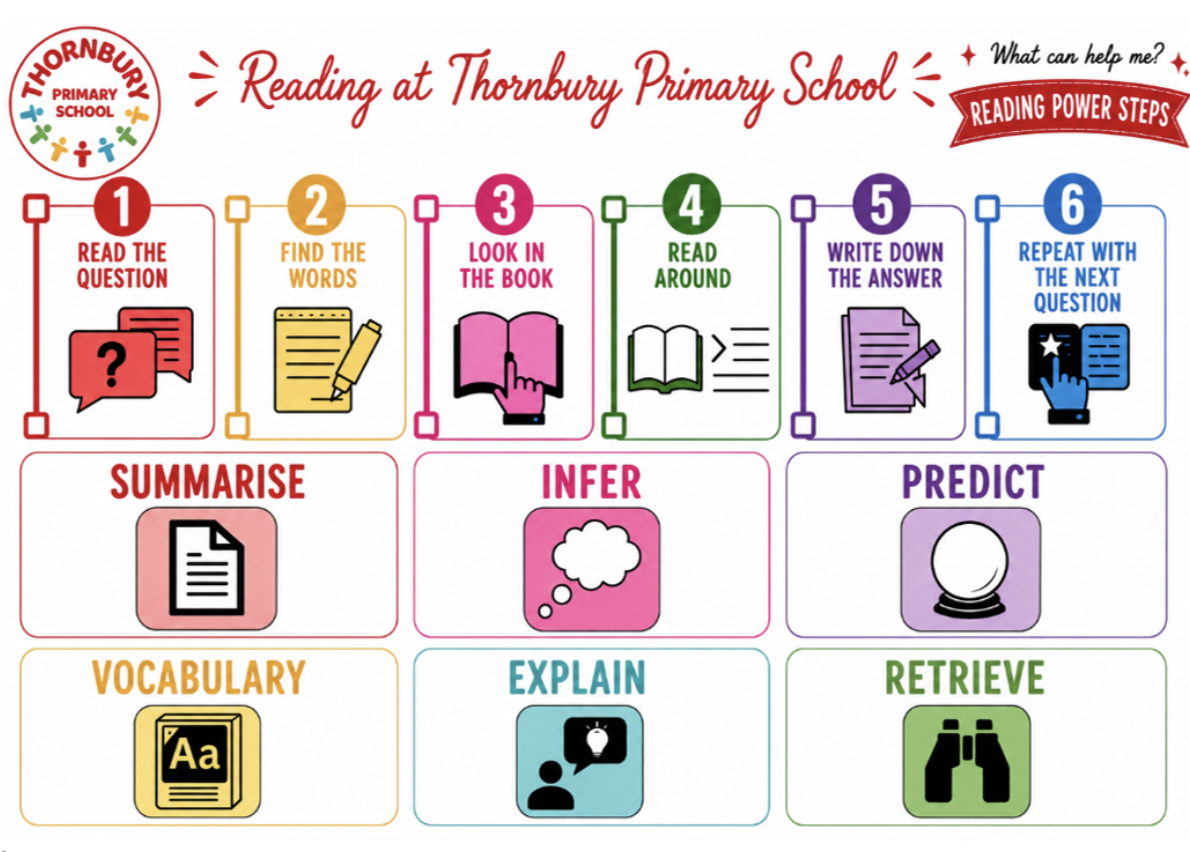
In school, we complete a range of reading activities throughout the week, including having a class book/s and a reading comprehension practice. The focus for these is to continually extend the children’s sight vocabulary, developing reading fluency and comprehension of texts read. The children are encouraged to use our Reading Power Steps, which encourage the children to use the text to support their answers. Our reading comprehension skills are focused on VIPERS.
This year, we will continue to develop our love of reading through a wide range of fiction, non-fiction, poetry and plays, giving children opportunities to explore different authors, genres, themes and styles of writing.
Our guided reading sessions are carefully structured across the week to develop both comprehension skills and reading independence.
Monday, Tuesday & Wednesday
At the beginning of each week, children will explore a chosen text in depth. This may be a fiction extract, non-fiction text, poem or play. Through discussion, questioning and close reading, pupils will explore vocabulary, characters, themes, meaning and the author’s choices.
We will develop a range of reading skills, including retrieval, inference, prediction, summarising, vocabulary and understanding how texts are structured and written. Children will be encouraged to justify their ideas using evidence from the text and to explain their thinking in increasing detail.
Thursday – Guided Independent Reading
On Thursdays, children will apply the skills they have developed earlier in the week to a new, independently explored extract. This text will have connections to the week's learning, allowing pupils to transfer their understanding and make links between texts, ideas and authors.
This session provides an opportunity for children to demonstrate their comprehension skills with increasing independence while still benefiting from carefully guided support where needed.
Friday – Becoming Independent Readers
Our Friday sessions give pupils the opportunity to put their reading skills into practice independently. Children will tackle a range of questions and activities, drawing on the strategies they have developed throughout the week.
The aim is to build confident, resilient readers who can think deeply about what they read, explain their ideas, make connections and support their answers with evidence.
Across Autumn 1 and Autumn 2, we will continue to nurture a genuine love of reading, encouraging children to read widely, discuss books enthusiastically and become increasingly independent, thoughtful and confident readers.
We are passionate about children developing a love of reading; we ask that families read with and hear their children read or encourage their child to read independently for the equivalent of approx. 1 and ½ hours weekly.
Accelerated reader
At Thornbury, we want every child to discover the joy of reading! Accelerated Reader helps our pupils become confident, independent readers by encouraging them to choose books that are just right for their reading level and, most importantly, books they are excited to read.
In Year 5 and 6, Accelerated Reader is particularly valuable as children become more independent and begin to explore a wider range of books, authorsand genres. Pupils can choose books that challenge their thinking, build their vocabulary and develop their comprehension skills, while still enjoying stories that capture their imagination.
Once they have finished a book, children can take a fun quiz to check their understanding and earn points along the way. They can track their progress, set themselves reading goals and celebrate their achievements. Our teachers also use this information to support children in making great book choices and continuing to develop their reading skills.
Most importantly, Accelerated Reader helps us to encourage a love of reading beyond the classroom. We want our Year 5 and 6 pupils to become enthusiastic, confident readers who are excited to pick up a book, discover new worlds and share their reading recommendations with others!
Home Learning:
To help prepare pupils for the transition into secondary, there is the expectation for children to have homework focused on Maths, SPaG& Reading. There will be 10 spellings a week for children to practice and these will be tested on the Friday (where possible).
We have spoken to the children about how homework supports and strengthens their learning. To encourage participation, and to prepare them for KS3, any homework submitted either via Dojo or in class, will earn Dojo points as a reward.
Online Resources:
You will find your login details for the following site at the front of your reading diary.
Times Tables Rockstars: www.ttrockstars.com
Language Angels: www.languageangels.com
Curriculum- Yearly overview of topics
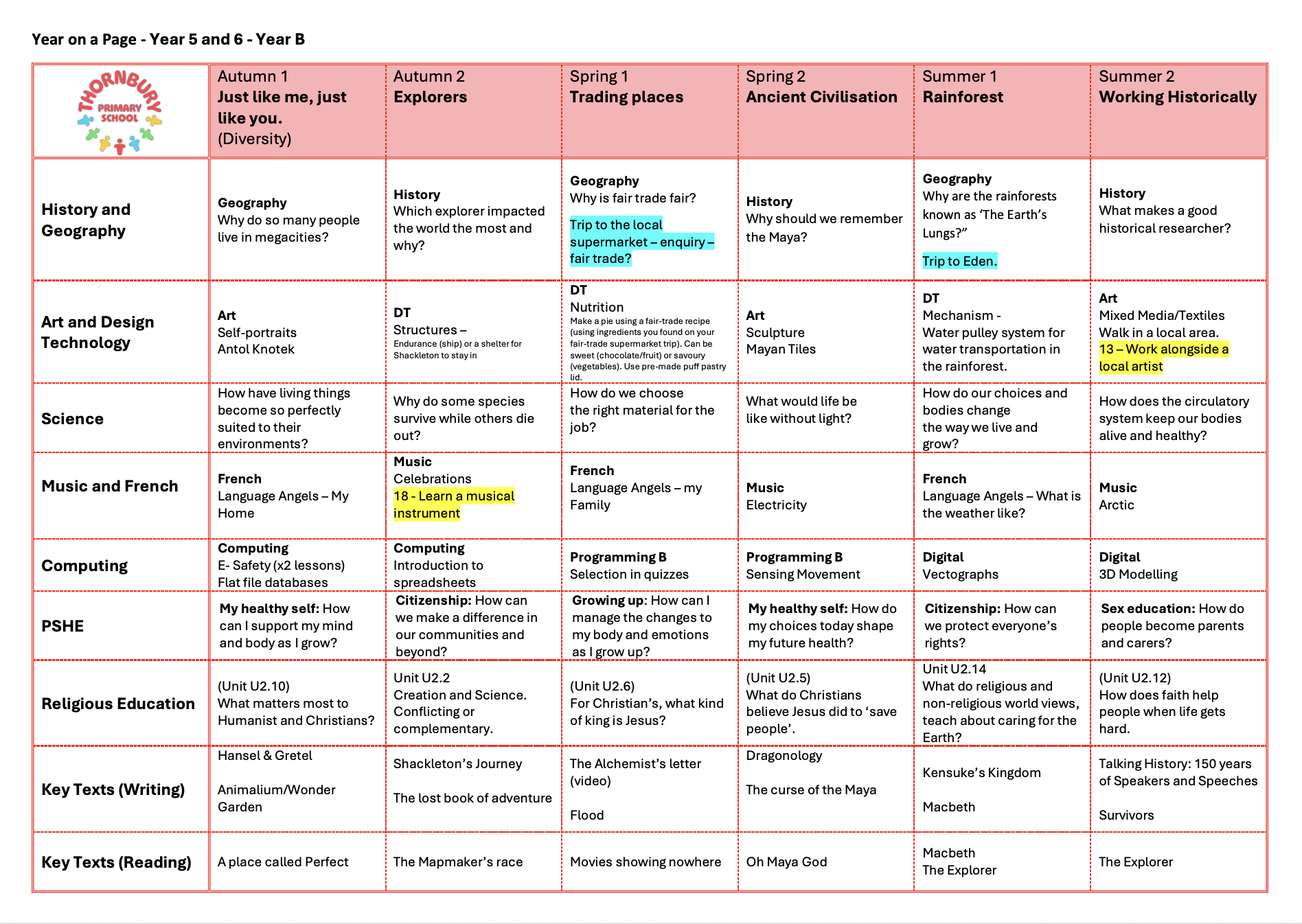
Topics Covered Throughout the Year:
English:
Autumn 1:
We will begin our English journey by exploring Neil Gaiman’s version of Hansel & Gretel and comparing it with the original 1812 tale by the Brothers Grimm. We will investigate how the two versions differ in their characters, language, atmosphere and storytelling, considering how authors can transform traditional tales for a modern audience.
The children will then become authors themselves, innovating their own versions of the tale and adding their own creative twists. They will carefully select vocabulary and use a range of writing techniques to create suspense and atmosphere, transporting their readers into their own magical and mysterious worlds.
Our next unit will take us from fairy tales into the fascinating world of animals. Using Animalium and The Wonder Garden as inspiration, the children will research and write their own non-chronological reports. They will develop their ability to organise information clearly and effectively, using relative clauses to add extra detail and parenthesis to provide additional information without interrupting the flow of their writing.
To bring their learning to life, the children will produce a published final report, complete with their own original artwork of their chosen animal.
Autumn 2:
In Autumn 2, our English and History learning will combine as we journey back to the Heroic Age of Antarctic Exploration and explore the incredible expedition of Ernest Shackleton. Through historical texts and Shackleton’s experiences, the children will immerse themselves in the challenges and dangers faced during his expedition.
The children will write their own published diary entries, adopting the perspective of an explorer and using show, not tell to reveal emotions and experiences to the reader. They will carefully consider how to convey fear, excitement, determination and uncertainty through actions, thoughts, descriptions and carefully chosen vocabulary, helping the reader to understand what it was like to face such a perilous journey.
We will then turn our attention to poetry, inspired by The Lost Book of Adventure. The children will explore how poets can use language creatively to capture the excitement and dangers of exploration. They will read, perform and write a range of poetry, including kennings and haiku, experimenting with vocabulary, imagery, rhythm and structure.
Throughout the term, the children will be encouraged to become confident readers, imaginative writers and thoughtful editors, developing their vocabulary and understanding of how authors use language to engage and influence their readers.
Spring 1:
We will begin the spring term by exploring a narrative inspired by The Alchemist’s Letter, alongside a Literacy Shed film that provides a rich stimulus for developing atmosphere and descriptive writing. Children will explore how authors and filmmakers create tension and mood, using a range of literary devices including pathetic fallacy, similes, metaphors and personification. They will apply these techniques to their own narrative writing, developing their ability to select precise vocabulary and create vivid images for the reader.Our second unit will explore floods, linking closely with our Geography learning. Children will investigate a range of poetic forms, including haikus and kennings, experimenting with rhythm, imagery, vocabulary and figurative language to capture the power and impact of flooding.
Spring 2
Children will enter the world of Dragonology, exploring the features and conventions of information texts. They will investigate how authors combine factual information, illustrations, diagrams, labels and engaging descriptions to create informative texts. Children will then research a topic of their own choice and apply their learning to create an original double-page-spread ‘ology’ book, developing their research, organisation, vocabulary and non-fiction writing skills.
We will then travel back in time through The Curse of the Maya. Children will explore Mayan culture, mythology and storytelling before creating their own Mayan myth. They will develop characters, settings and plot whilst focusing particularly on the use of dialogue to reveal character and advance the action.
Summer 1
Through the much-loved novel Kensuke’s Kingdom, children will develop their ability to write extended narrative. They will focus on Chapter 4, when Michael falls overboard, nearly drowns and wakes alone on a mysterious beach. Children will create their own version of the chapter, developing the setting and atmosphere while carefully linking the environment to Michael’s emotions, experiences and the progression of the plot. They will continue to develop their use of ambitious vocabulary, figurative language, varied sentence structures and cohesive narrative writing.
We will also explore Shakespeare’s Macbeth through narrative poetry. Children will respond creatively to the events, characters and themes of the play, experimenting with poetic techniques, imagery and language to retell and reinterpret key moments.
Summer 2
Our final English unit will focus on the power of speaking and persuasion. Inspired by our History learning about 150 years of speakers and speeches, children will explore how speeches can inform, persuade, inspire and create change. They will investigate the techniques used by influential speakers before researching an issue that is important to them. Children will then plan, write and deliver their own persuasive speech, incorporating relevant contextual information, rhetorical devices and carefully selected vocabulary. This unit will provide an opportunity for children to develop their oracy, confidence and ability to communicate ideas effectively to an audience.
Autumn Term:
Maths
This term in Maths, we will begin by revisiting and developing our key arithmetic skills, ensuring children have a secure understanding of the four operations: addition, subtraction, multiplication and division.
Our learning will include place value, square and cube numbers, long multiplication, long division and short division, alongside a range of other important arithmetic skills. We will build children’s confidence in applying these methods to solve a variety of increasingly challenging problems.
We will also focus on fractions, exploring how to order, compare and convert fractions. Through practical activities and problem-solving, we aim to help children develop both their mathematical understanding and confidence.
Science –
Autumn 1, in Science, we will be exploring evolution and inheritance. The children will investigate how living things have changed over time and how characteristics can be passed from parents to their offspring.
Throughout the unit, children will learn about variation, adaptation and natural selection, considering how different characteristics can help living things survive in their environments. They will explore evidence from fossils and use examples of plants and animals to understand how species have changed over many generations.
Children will also learn how living things inherit characteristics from their parents, and will explore the difference between characteristics that are inherited and those that are influenced by the environment.
Science, in Autumn 2, children will explore how animals are adapted to the environments in which they live. They will begin by investigating what adaptation means and examining a range of animals to discover how physical and behavioural adaptations help them survive. Children will consider how features such as camouflage, body shape, fur, claws and beaks can help animals find food, avoid predators and cope with different environmental conditions.
Children will then become designers of their own adapted animal, using their knowledge of habitats and adaptation to plan an animal that is well suited to a particular environment. They will make predictions and justify the adaptations they have chosen, developing their scientific enquiry and reasoning skills.
Art
In Art, the children will be exploring self-portraits and discovering how artists can communicate identity, ideas and emotions through both images and words. They will learn about typography – how designers use fonts and layout – and explore how the style, size and arrangement of words can help communicate different feelings and ideas.
Children will develop their drawing skills by experimenting with pressure, tone, gradients and overlap, learning how changes in pressure can create different shades and tones. They will explore how text can also be used creatively to add tone and meaning to their artwork.
Geography
In Geography the children will be studying megacities, answering the big question; Why do so many people live in megacities?They will look at the features of a megacity and how a city can qualify to become a megacity. They will also study the megacity of Brasilia (the fastest growing city in Brazil). They will use their prior knowledge of the Amazon and jungles.
They will look at the advantages and disadvantages of living in a megacity compared to other areas of the world. They will also complete some fieldwork on the population data and how the population affects the cities data.
History
In History, Year 5/6 will be answering the big question; Which explorer impacted the world the most and why? They will be studying and comparing different explorers, when they were alive and what their achievements are. They will also look at different sources, both primary and secondary and use them to find the different explorers’ achievements.
They will study; Shackelton, Darwin and Linnaeus. They will look at each explorer, the life they led and the impact that each of them had on scientific advancement.
PSHE
In PSHE, the children will be exploring “My Healthy Self”, focusing on the different ways we can look after our physical and emotional wellbeing. They will learn how making healthy food choices, staying physically active and looking after their mental health all contribute to a healthy and balanced lifestyle.
Throughout the unit, children will develop their understanding of complex feelings and emotions, learning to recognise how they may feel and exploring positive strategies for managing difficult or overwhelming emotions. They will also consider the importance of talking about their feelings and seeking support when they need it.
RE
Our Year 5 and 6 pupils will explore the big question: “What matters most to Humanists and Christians?” They will learn about rules, Christian and Humanist beliefs, and the values they share, such as kindness, honesty, fairness and respect. Pupils will explore different codes for living, discuss different viewpoints and develop their confidence in sharing and listening to ideas. They will finish the unit by presenting their learning.
Our focus will move to “Creation and Science – conflicting or complementary?” Pupils will explore Christian beliefs about creation alongside scientific explanations, including evolution and the origins of life and the universe. They will consider different viewpoints and develop their skills in asking questions, discussing evidence and respectfully exploring whether faith and science can work alongside each other.
PE
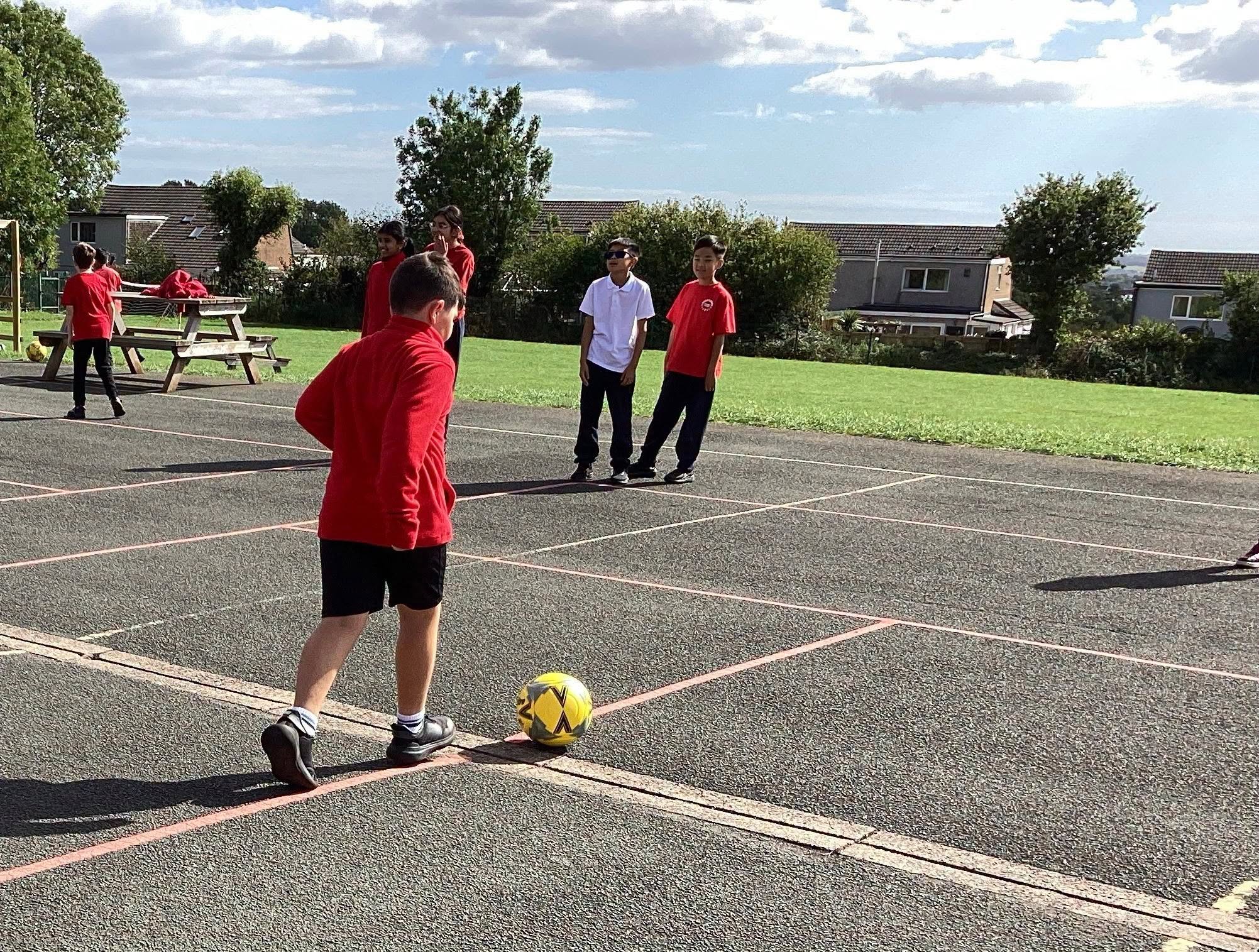
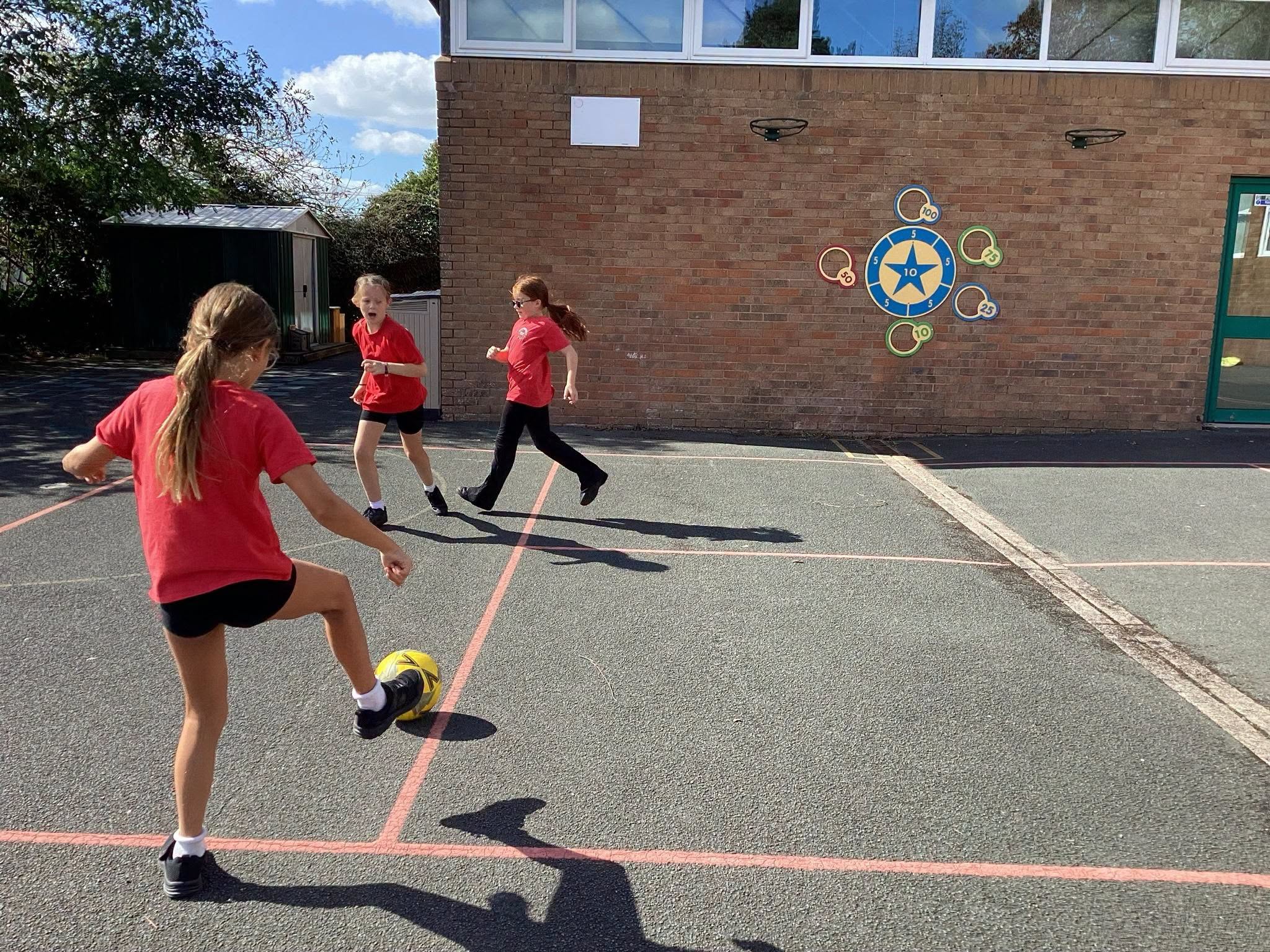
In PE, children will develop their skills, confidence and teamwork through invasion games and dance. In invasion games, they will practise moving with and without the ball, passing, receiving, attacking and defending. They will learn how to work effectively as part of a team, make decisions during games and use tactics to outwit opponents.
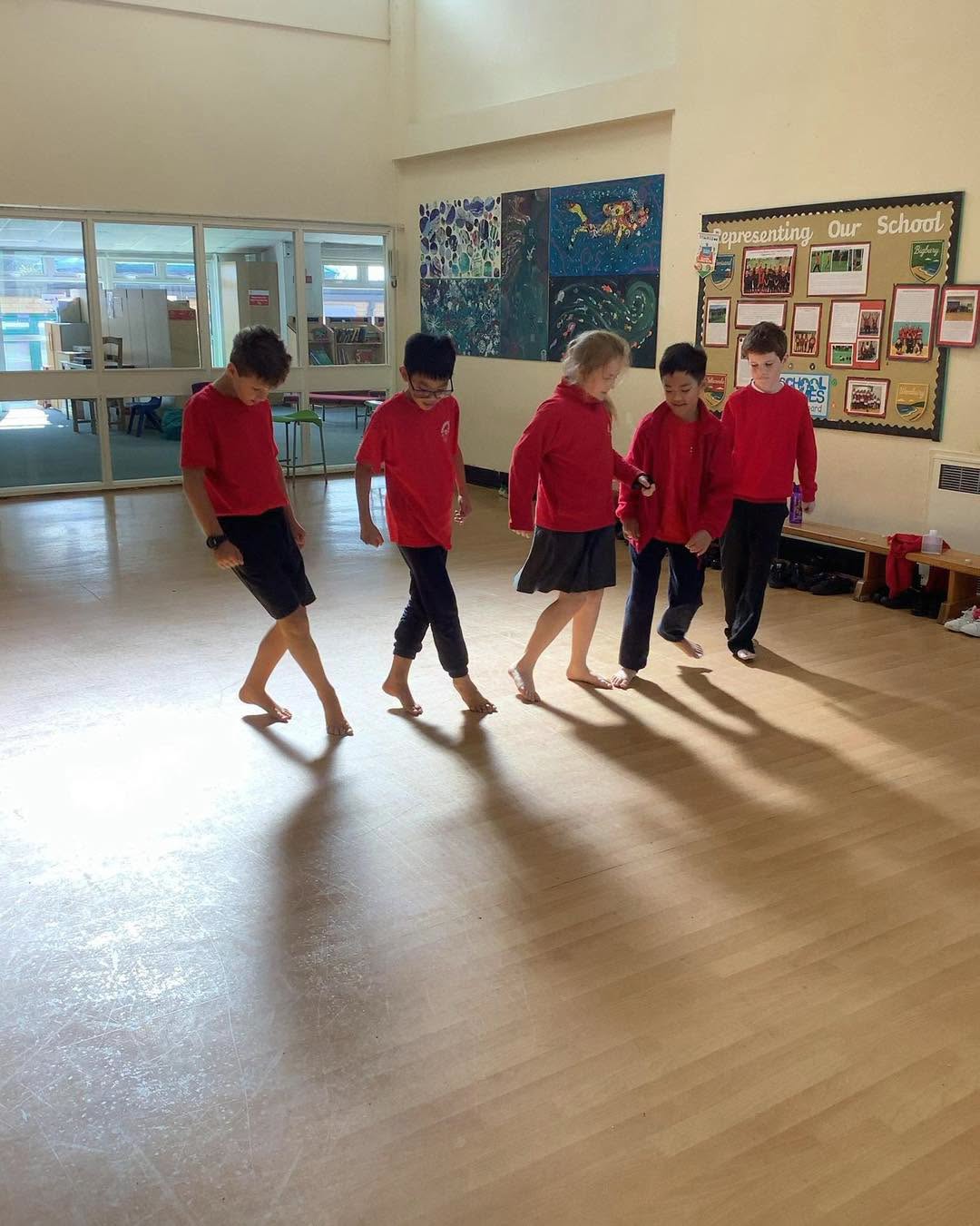
During our dance unit, children will explore movement, rhythm and expression. They will develop sequences using different actions, levels, directions and dynamics, while working collaboratively to create and perform dances. Across both units, children will develop their physical fitness, coordination and communication skills, while learning the importance of cooperation, resilience and fair play.
Computing
In Computing, the children will be learning how flat-file databases can be used to organise, search and make sense of information. They will explore how data can be arranged into fields and records and use database tools to sort, filter and search data to answer questions and solve problems.
Children will learn how presenting data visually through graphs and charts can make information easier to understand and help them identify patterns and draw conclusions. They will also work with a real-life database, using their skills to investigate a question and find meaningful information.
Music
In Music this term we will study 4 celebrations around the world, Chinese New Year (China), St Patrick’s Day (Ireland), Punjabi Weddings (Pakistan/North India) and Rio Carnival (Brazil). Pupils will learn that celebrations are an important aspect of culture, bringing communities together through dance and music. This term the children will be exposed to different styles of music that are used in celebrations. Pupils will listen to and appraise music for each celebration.
D and T
In Design & Technology, children will take inspiration from Sir Ernest Shackleton’s famous ship, Endurance, exploring its history and researching how it was designed and built. They will investigate the shapes, materials, joining methods and construction techniques that could be used to create their own model, developing their understanding of how designers use research to inform their ideas.
Children will then follow the design process to plan, make and evaluate their own model of Endurance. They will experiment with materials and techniques, make decisions about the most suitable ways to construct their model and evaluate how successfully their finished product meets their design criteria. Through this project, children will develop their creativity, problem-solving, practical skills and ability to reflect on and improve their work
French
In French pupils will be gaining the knowledge and skills to present both orally and in written form about where they live and which rooms there are and aren't in their homes in French. This is a unit that focuses on recycling previously learnt grammar, using it with new vocabulary, conjunctions and grammar, demonstrating a growing ability to create independent responses.
Spring Term:
Maths
This term, our 6 pupils will develop their mathematical fluency, reasoning and problem-solving skills through a range of exciting topics. We will strengthen our understanding of multiplication and division, using formal methods and applying these skills to a variety of increasingly challenging problems.
We will explore fractions and decimals, learning how to compare, order and calculate with them. Pupils will also make important connections between fractions, decimals and percentages, developing their understanding of how these different representations of numbers work together.
We will also investigate area, perimeter and volume, applying our knowledge to practical and real-life problems. Throughout the term, pupils will be encouraged to explain their thinking, tackle challenges, choose efficient methods and learn from their mistakes, helping them to become confident and resilient mathematicians.
Science
In Science this term, children will explore the fascinating world of light through the enquiry question: “What would life be like without light?” They will begin by exploring what they already know about light and developing their scientific vocabulary before investigating how light travels and how we are able to see the world around us.
As part of the unit, children will learn about Ibn al-Haytham, a pioneering scientist from the Islamic Golden Age whose work on light, vision and scientific investigation helped shape our understanding of how we see. Throughout the unit, children will develop their scientific enquiry skills while discovering just how important light is to the world around us.
Art
In Art this term, children will be inspired by the Ancient Maya and their rich artistic traditions. They will explore who the Maya were and investigate how we know about their culture and creativity through surviving artwork, sculptures and other historical evidence. Children will look closely at Mayan sculptures and hieroglyphs, identifying how artists used line, shape and pattern to communicate ideas and create detailed designs.
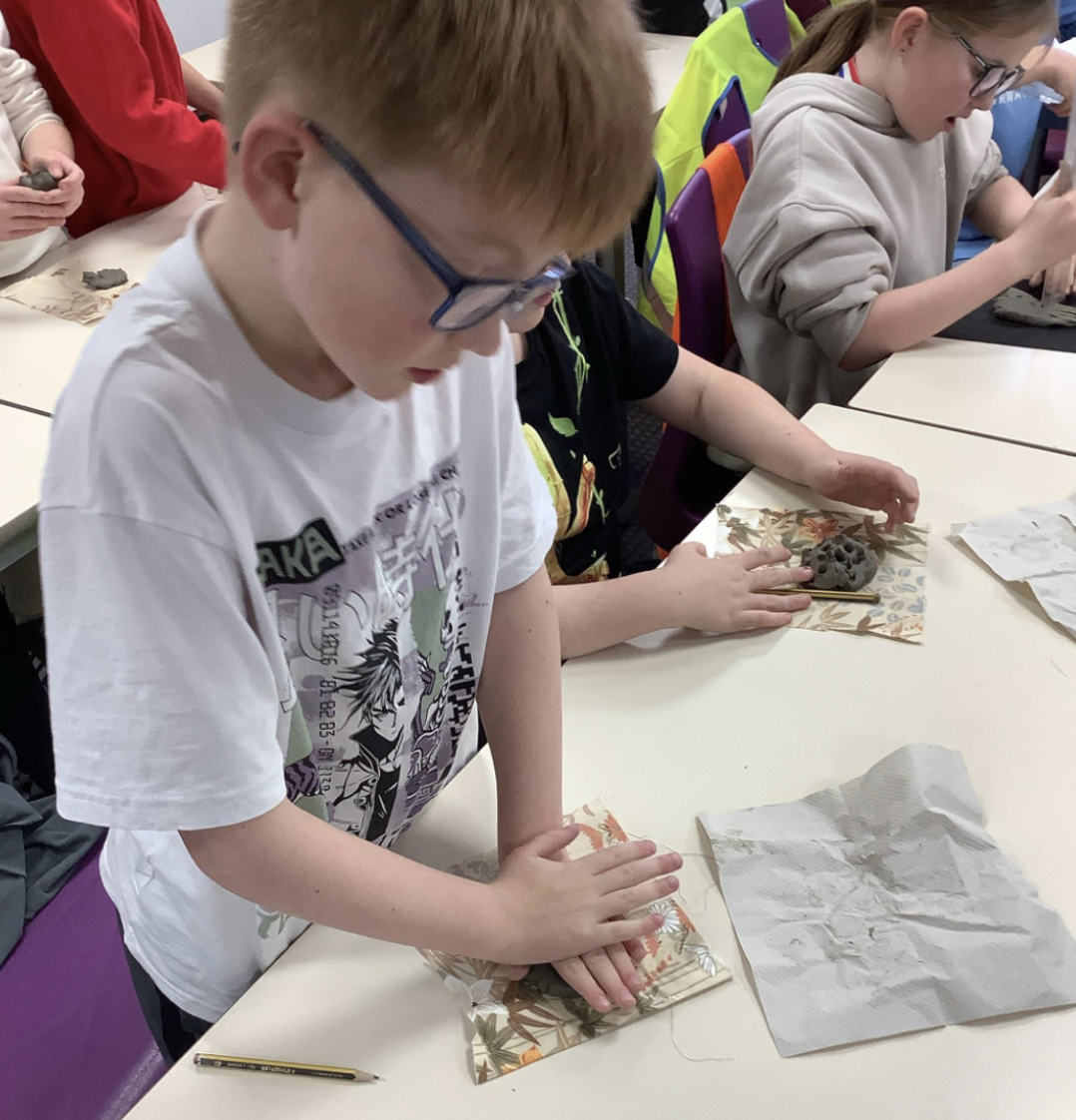
Children will then experiment with clay, learning how to create a clay slab and exploring different techniques for adding texture, line, shapeand pattern. They will practise a range of ways to embellish clay, developing their control and confidence with the material before creating their own Mayan-inspired artwork.
Geography
In Geography this term, children will explore the question “Why is Fair Trade fair?” They will investigate where everyday products come from and learn about the journeys food and other goods can take from producers around the world to the shops where we buy them.
As part of their enquiry, children will visit a local supermarket to investigate Fairtrade products and compare them with other products. They will consider who produces the goods we buy, how they are traded and why Fairtrade schemes aim to support farmers and workers. Children will develop their geographical skills by collecting information, asking questions and using their findings to form conclusions about whether Fair Trade really is fair.
History
In History this term, children will explore the fascinating civilisation of the Maya, investigating the enquiry question “Why should we remember the Maya?” They will discover when and where the Maya lived and explore what their civilisation was like, including their cities, homes, religion, beliefs, writing, mathematics and impressive understanding of astronomy.
Children will work with a range of historical sources and evidence to find out about the Maya and consider what these sources can tell us about their lives. They will investigate the achievements and innovations of the Maya, while also exploring important aspects of Maya society and considering how historians build an understanding of the past.
PSHE
In PSHE this term, children will learn about growing up and the changes that happen during puberty. We will explore what puberty is, why it happens and the physical changes children may experience, using correct scientific vocabulary. Children will also learn how these changes can affect personal hygiene and why good personal care is important for keeping ourselves healthy and comfortable.
We will also explore the emotional changes that can happen during puberty, helping children understand that feelings can change and that everyone experiences growing up differently. Children will learn about periods, why they happen and the different products that can be used to manage them, ensuring that they have accurate, age-appropriate information and feel comfortable asking questions.
RE
Our Year 5 and 6 pupils will explore the big question: “For Christians, what kind of king is Jesus?” They will discover what the Bible teaches about Jesus as King and Messiah, exploring qualities such as humility, compassion, service, justice and love. Pupils will consider how Jesus’ example influences Christian life today and develop their skills in sharing ideas, asking questions and listening respectfully to different viewpoints.
Our focus will move to “What do Christians believe Jesus did to ‘save people’?” Pupils will explore the death and resurrection of Jesus and key Christian ideas including forgiveness, sacrifice and salvation. Through Bible stories, discussion and reflection, they will consider why Easter is so important to Christians and develop their understanding of different perspectives.
PE -
In PE, Year 6 will develop their health and wellbeing through activities focused on stamina, strength and flexibility, building their fitness and understanding of how exercise supports a healthy lifestyle. The focus is Move.
Children will also explore Gymnastics through matching and mirroring, working with others to develop control, coordination and awareness. They will focus on responding to and reflecting their partner’s movements, with a focus on Think.
Spring 2
Year 6 will develop their invasion game skills through tag rugby, exploring different scenarios and tactics. They will make decisions about attacking, defending and creating space, with a focus on Move.
Computing
In Sping, Children will be building on their prior programming knowledge. In this unit, children develop their knowledge of selection by revisiting how conditions can be used in programs and then learning how the If… Then… Else structure can be used to select different outcomes depending on whether a condition is true or false. They represent this understanding in algorithms and then by constructing programs using the Scratch programming environment. They use their knowledge of writing programs and using selection to control outcomes to design a quiz in response to a given task and implement it as a program.
Music
In Music, the children will develop their understanding of beat, rhythm and notation. They will explore how beats are organised into bars and practise performing different rhythm patterns while keeping a steady beat. Children will experiment with combining rhythms, including using different layers of sound.
They will also develop their understanding of pitch and the stave, improving their accuracy when singing and playing tuned percussion. Children will explore more complex rhythms and begin to recognise the difference between 3 and 4 beats in a bar, developing their confidence and fluency when performing.
D and T
In Design & Technology this term, children will explore nutrition, food choices and Fairtrade. They will learn about where ingredients come from and consider how choosing Fairtrade products can help support farmers and producers around the world. Using ingredients identified during their Fairtrade supermarket trip, children will develop their understanding of food preparation and making informed choices about the ingredients they use.
As their practical project, children will design and make their own pie, choosing between a sweet filling such as chocolate or fruit, or a savoury filling using vegetables. They will follow a Fairtrade-inspired recipe, prepare and combine their ingredients safely and use a pre-made puff pastry lid to complete their pie. Children will develop their cooking skills while considering flavour, presentation and the nutritional value of their finished product.
French
In French this term pupils will have the knowledge and skills to explain their own/a fictitious family in both spoken and written form in French. Pupils will start to integrate previously learnt language with newly acquired language, encouraging more confident use of their growing bank of vocabulary. Pupils will demonstrate an increasing knowledge of grammar and the use of the possessive in French to manipulate language, thus starting to create more personalised responses as the unit supports the change from 1st person singular to 3rd person singular.
Summer Term:
Maths
This term, our 6 pupils will continue to develop their mathematical fluency, reasoning and problem-solving skills while preparing for their SATS. We will begin by exploring ratio and algebra, building confidence in recognising patterns, solving problems and applying mathematical thinking to different situations. We will also revisit key areas of learning to ensure pupils feel prepared and confident.
We will explore shape, position and direction, developing our understanding of angles, coordinates and movement. Pupils will also work with statistics, interpreting tables, graphs and charts and using data to solve problems. Alongside this, we will investigate converting units, applying our knowledge of measurement to practical and real-life problems.
Throughout the term, there will be a strong focus on SATS preparation, with opportunities to revisit and consolidate key skills, practise different question types and develop effective problem-solving strategies. We will encourage pupils to work carefully, explain their thinking, persevere with challenges and build confidence, helping them to approach their SATS with a positive and resilient attitude.
Science
In Science this term, children will explore the enquiry question “How does the circulatory system keep our bodies alive and healthy?” They will learn about the heart, blood and blood vessels and discover how the circulatory system transports oxygen and nutrients around the body while carrying away waste products such as carbon dioxide.
Children will investigate how the heart works as a pump and explore the different components of blood, including red blood cells, white blood cells, platelets and plasma. They will also consider how exercise affects the heart and breathing rate and why regular physical activity, a balanced diet and healthy lifestyle choices help to keep our circulatory system healthy.
Art
In Art this term, children will explore how mixed media and embellishment can be used to tell stories and communicate ideas. They will be inspired by the work of artist Sarah Sanders, exploring how she uses fabric, stitching, texture and decorative techniques to representjourneys and experiences.
Children will experiment with a range of textile techniques, learning different types of stitches and discovering how these can be used to add detail, texture and meaning to their artwork. They will also explore appliqué, learning how pieces of fabric can be layered and attached to create patterns and images.
Geography
In Geography this term, children will explore the enquiry question “Why are the rainforests known as ‘The Earth’s Lungs’?” They will investigate the location and characteristics of tropical rainforests around the world, exploring their climate, layers and incredible biodiversity. Children will learn about the important role rainforests play in supporting life on Earth and consider how they are connected to the wider global environment.
As part of their learning, children will visit the Eden Project, where they will experience rainforest environments first-hand and deepen their understanding of tropical climates, plants and ecosystems. They will use what they discover to explore the importance of rainforests, the threats they face and why protecting these valuable environments matters.
History
In History this term, children will explore the enquiry question “What makes a good historical researcher?” They will develop the skills historians use to investigate the past, including asking effective questions, finding and selecting reliable information, and using evidence to build a clear understanding of historical events, people and themes.
Children will explore the Thornbury History themes and learn how to research effectively using a range of sources. They will consider how to identify useful information, organise their findings and distinguish between reliable evidence and information that may be less trustworthy.
PSHE
In PSHE this term, children will explore human rights, laws and the role of the legal system in helping to create a fair and safe society. They will consider why laws are important, how they protect people and communities, and what can happen when laws are broken.
Children will also explore prejudice, discrimination and stereotypes, considering how these can affect individuals and communities. They will discuss how stereotypes can be challenged and how we can promote equality, respect and inclusion in our everyday lives.
RE
Our Year 5 and 6 pupils will explore “What do religious and non-religious worldviews teach about caring for the Earth?” They will consider how Christians, Humanists and others understand our responsibility to care for the planet, exploring issues such as climate change, protecting wildlife and sustainable living. Pupils will share ideas, listen respectfully to different viewpoints and reflect on how small actions can make a big difference.
Our focus will move to “How does faith help people when life gets hard?” Pupils will explore how faith, beliefs, community and personal values can provide hope, comfort and strength during challenging times. Through stories, discussion and reflection, they will consider different perspectives and think about where people can find hope and support when life is difficult.
PE -
Summer A
In PE, Year 6 will develop their striking and fielding skills through rounders, exploring tactics and making decisions to improve their team’s performance. The focus is Think.
Children will also take part in Athletics, developing their skills through a range of athletic challenges and working to improve their personal performance. The focus is Move.
Summer B
Year 6 will develop their Outdoor Adventurous Activity (OAA) skills through leadership activities, working collaboratively and taking responsibility for supporting others. The focus is Connect.
Children will also explore Parkour, developing their movement, agility, balance and control as they navigate different challenges. The focus is Feel.
Computing
In Computing, learners start to create vector drawings. They learn how to use different drawing tools to help them create images. Children will recognise that images in vector drawings are created using shapes and lines, and each individual element in the drawing is called an object. Children layer their objects and begin grouping and duplicating them to support the creation of more complex pieces of work.
Music
In Music, the children will explore instrument families, including strings, woodwind, brass, percussion and electronic instruments. They will investigate the different sounds and qualities of instruments and explore how these can be represented through graphic notation.
Children will explore musical structure, learning how sections can be organised and repeated to create different forms such as rondo. They will also investigate how music can represent ideas, events and changing moods.
Children will develop their understanding of texture and layers, composing soundscapes using different parts that enter and leave at different times. They will explore how dynamics and layers can be represented through graphic scores. Year 6 will begin developing multi-layer rhythm and graphic notation grids, while Year 6 will progress towards notating their own rhythmic compositions using standard notation and complete graphic scores.
D and T
In Design & Technology this term, children will explore mechanisms and pulley systems through a real-world challenge: how could water be transported more easily in a rainforest environment? They will investigate how pulley systems work and explore how simple mechanisms can make tasks easier by changing the direction or reducing the effort needed to move a load.
Children will research, design and make their own water transportation pulley system, selecting suitable materials and considering how their mechanism could work effectively in a rainforest setting. They will test and refine their designs, solving problems and making improvements as they develop their practical skills.
French
In French this term pupils will have the knowledge and skills to describe the weather and present a weather forecast in the foreign language. This enables us to link the weather vocabulary with map work, compass points and general geography. This unit improves both language and cultural knowledge.
Meet the team






Class gallery